Wisdom Tooth Removal in Gudivada
Safe extraction of impacted or problematic wisdom teeth. Expert care, minimal discomfort, and fast recovery with our experienced oral surgeons.
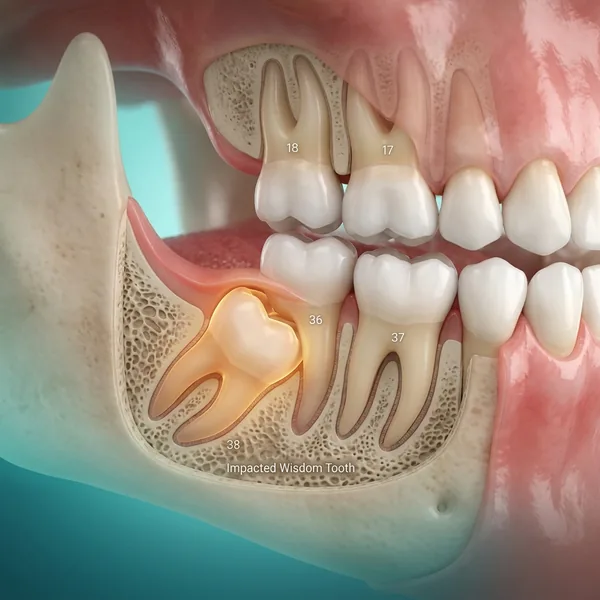
Why wisdom teeth cause problems
Wisdom teeth (third molars) are the last teeth to develop, usually erupting in your late teens to early twenties. Most people don't have enough jaw space for them to grow properly.
When wisdom teeth come in at wrong angles or don't have room to erupt fully, they can become impacted, causing pain, infection, and crowding of nearby teeth. Early removal prevents complications and makes recovery much faster.
At Krishna Multispeciality Dental Clinic in Gudivada, removal starts from Rs 800 (X-ray Rs 200) and is carried out under local anaesthesia by our experienced oral surgeons, working under Dr. Vidya Sahithi Atluri, MDS (Prosthodontist). We begin with an advanced X-ray to see the exact position, angle, and depth of each wisdom tooth before planning the safest extraction technique, and most patients return to normal activities within 2 weeks.
What are the signs you might need removal?
Pain at the back of mouth
Sharp or throbbing pain at the back of your jaw, especially around the molars. This often worsens when chewing.
Swollen or inflamed gums
Gums around the back molars are tender, red, or swollen — sometimes with difficulty opening your mouth.
Jaw stiffness and limited opening
Difficulty opening your mouth wide or feeling stiffness in your jaw, making eating and speaking uncomfortable.
Crowding of other teeth
Your front teeth are becoming crowded or shifting position, pushing against other teeth and affecting your bite.
How do we extract wisdom teeth?
X-ray & assessment
We take advanced X-rays to see the exact position, angle, and depth of your wisdom teeth. This allows us to plan the safest extraction technique.
Treatment planning
We discuss the procedure, options (single or multiple extractions), and expected recovery time. You'll understand exactly what to expect before we begin.
Extraction procedure
Under local anaesthesia, our experienced oral surgeons carefully perform the tooth extraction using precise techniques. The entire procedure is painless, though you may feel pressure or hear sounds.
Recovery guidance
We provide detailed post-operative instructions including medications, dietary recommendations, and activity restrictions. Most patients return to normal activities within 2 weeks.
Follow-up check
We schedule follow-up visits to ensure proper healing and address any concerns. Any stitches are removed as needed, and we monitor your recovery.
Expert surgical care
Experienced oral surgeons
Our surgeons have extensive training and experience in complex wisdom tooth extractions with proven track records of safe, successful procedures.
Minimal discomfort
Using modern techniques, precision instruments, and effective anaesthesia, we ensure your procedure is as comfortable as possible with minimal pain.
Fast recovery
Most patients experience minimal swelling and return to normal activities within 2 weeks. Our post-operative care instructions ensure smooth, speedy healing.
Comprehensive aftercare
We provide detailed instructions, medications, and follow-up care to prevent complications. Our team is available for any questions during your recovery.
How do you recover from wisdom tooth removal?
Swelling typically peaks around day two and gradually improves — ice packs on the cheek for the first 24 hours, and switching to warm salt-water rinses after that, help manage it. As with any extraction, avoid straws, forceful spitting, and smoking for at least a few days, since these can dislodge the healing blood clot and cause a painful dry socket.
Stick to soft, cool foods for the first couple of days, take pain relief as advised, and any dissolvable stitches will disappear on their own within one to two weeks. Most patients are back to normal activities within 3–5 days, though full healing of the gum takes a few weeks longer.
Call us if you notice a fever, pus, or pain that gets worse after day three instead of easing — these can be signs of infection or dry socket, both of which are straightforward to treat quickly if caught early.
Do all wisdom teeth need to be removed?
Not always. A wisdom tooth that has grown in straight, is fully erupted, and doesn't cause crowding or hygiene problems can sometimes be left alone and simply monitored with periodic X-rays. The teeth that typically need removal are impacted (stuck against the tooth in front, or trapped in the jawbone) or partially erupted in a way that traps food and bacteria.
A digital X-ray lets us see the exact position and angle of your wisdom teeth and give you an honest recommendation — removal only when it's genuinely needed, not as a blanket rule. If removal is advised, earlier is usually easier, since roots are less developed and healing tends to be quicker in younger patients.
This is why removal is often recommended proactively in the late teens or early twenties, even before symptoms appear — waiting until a wisdom tooth is actively causing pain generally means a longer, more complex recovery.
A question we hear often is whether wisdom tooth removal is as painful or difficult as its reputation suggests. Most extractions, including impacted ones, are completed comfortably under local anaesthesia in a single visit, and the discomfort in the days after is generally very manageable with standard pain relief — the dramatic stories patients sometimes hear are the exception, not the rule, and often relate to cases where removal was delayed until infection had already set in. Waiting too long is usually what makes the experience harder, not the extraction itself. If your wisdom teeth are causing recurring discomfort, crowding, or difficulty cleaning properly, addressing it sooner rather than later generally means a simpler procedure and an easier recovery.