Root Canal Treatment in Gudivada
Save your natural tooth with gentle, modern root canal therapy. No pain, no fear — just expert care in the heart of Gudivada.
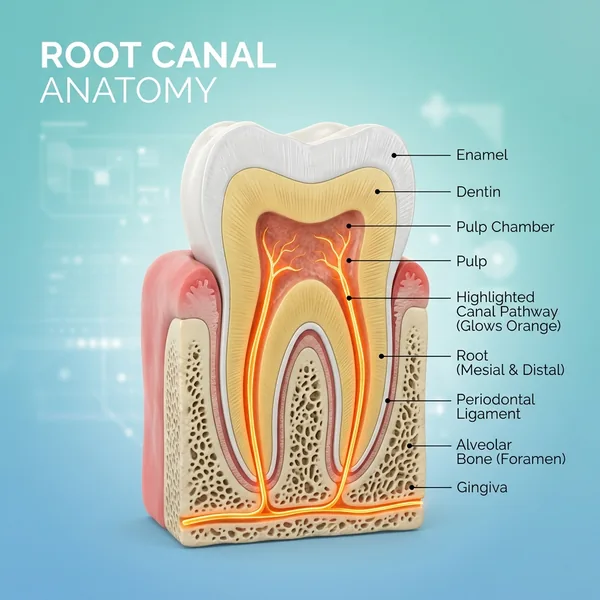
What is a root canal?
A root canal is a treatment to repair and save a tooth that is badly decayed or infected. During the procedure, the nerve and pulp inside the tooth are removed, and the interior is cleaned and sealed.
Despite its reputation, a modern root canal is no more uncomfortable than getting a filling. At Krishna Dental, we use the latest rotary instruments and digital imaging to make the process quick, precise, and virtually painless.
Treatment at Krishna Multispeciality Dental Clinic starts from Rs 2,500 and is performed personally by Dr. Vidya Sahithi Atluri, MDS (Prosthodontist), using digital X-rays and precision rotary instruments to clean and shape each canal accurately. Most standard infections are completed in a single sitting under 60 minutes; complex cases with an abscess may need a second visit before the tooth is sealed. The tooth is then protected with a custom-fit crown, such as zirconia or CAD/CAM ceramic.
When might you need a root canal?
Persistent toothache
Deep, throbbing pain that doesn't go away — especially pain that radiates to your jaw, face, or other teeth.
Sensitivity to hot & cold
A sharp or lingering ache when you drink something hot or cold, even after the source is removed.
Swollen or tender gums
Gums near the painful tooth are puffy, swollen, or have a small bump (abscess) that may ooze.
Darkened tooth
A tooth that has turned grey or dark — a sign that the nerve inside may be damaged or dying.
How is root canal treatment performed?
Diagnosis & imaging
We take a digital X-ray to see the shape of the root canals and determine the extent of infection. This helps us plan your treatment precisely.
Anaesthesia
The area around the tooth is numbed with local anaesthesia. You'll feel comfortable and relaxed throughout — most patients say they barely feel a thing.
Cleaning the canal
We create a small opening in the tooth and remove the infected pulp tissue using precision rotary instruments. The canals are carefully shaped and disinfected.
Filling & sealing
The cleaned canals are filled with a biocompatible material and sealed to prevent reinfection. A temporary or permanent filling is placed on top.
Crown placement
To protect and strengthen the treated tooth, we fit a custom dental crown that looks and feels like your natural tooth. This is usually done in a follow-up visit.
Root canal care you can trust
Experienced specialists
Our endodontists have performed thousands of successful root canal treatments with high success rates.
Modern equipment
Digital X-rays, rotary endodontic instruments, and apex locators for precise, efficient treatment.
Strict sterilisation
Every instrument is autoclaved. We follow international infection control protocols for your safety.
Affordable pricing
Transparent pricing with no hidden costs. We also offer flexible payment options so cost is never a barrier to care.
How do you recover after a root canal?
Mild soreness for a day or two is normal as the anaesthesia wears off — regular over-the-counter pain relief is usually enough to manage it. Avoid chewing on the treated side until your permanent crown is fitted, since the tooth is more brittle until then.
Keep brushing and flossing normally around the area, and avoid very hard or sticky foods on that tooth in the first few days. If you notice swelling, a fever, or pain that gets worse rather than better, call us right away — these aren't typical and are worth checking.
Most patients are back to work or normal activities the same day, since no sedation is used for a standard root canal — you're free to drive yourself home immediately after.
Root canal or extraction — which is right for you?
When a tooth is infected, the two realistic options are a root canal to save it, or extraction to remove it. Saving your natural tooth is almost always the better long-term choice: it keeps your bite, jawbone, and neighbouring teeth exactly as nature intended, with no gaps for other teeth to drift into.
Extraction may seem simpler, but it usually costs more in the long run — a missing tooth typically needs to be replaced with a bridge, denture, or implant to prevent bone loss and shifting teeth. Our MDS specialist will examine the tooth and X-rays to tell you honestly whether it can be saved.
For complex cases — multi-rooted molars, curved or calcified canals — the extra training an MDS specialist brings makes a real difference to the precision and success rate of the procedure, compared to a general referral.
A question we hear often is whether a root canal will actually hold up over years of normal chewing — and the honest answer is yes, provided the tooth is protected with a crown afterward and you keep up with routine check-ups. Root canal treatment has one of the highest long-term success rates in dentistry, and the vast majority of treated teeth go on to function normally for decades. What matters most for longevity isn't the procedure itself but what happens after: getting the permanent crown fitted promptly rather than delaying, and not skipping your six-monthly reviews so we can catch any recurring issue early, long before it becomes painful again.