Dental Implants in Gudivada
Restore your smile with permanent, natural-looking teeth. Dental implants are the gold standard for replacing missing teeth — and they look, feel, and function like the real thing.
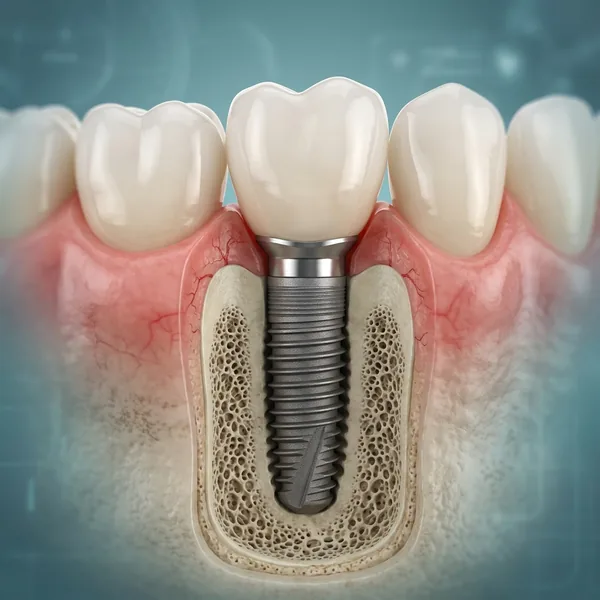
What are dental implants?
A dental implant is a tiny titanium screw that replaces the root of a missing tooth. Over time, it fuses with your jawbone in a process called osseointegration. Once stable, an abutment (connector) is attached to the implant, and a natural-looking crown is fitted on top.
The result is a tooth that feels, looks, and functions just like your natural teeth. Unlike dentures, implants don't slip or shift. Unlike bridges, they don't damage adjacent teeth. And unlike tooth extraction, they preserve your jawbone and facial structure.
Placement itself is a quick, comfortable procedure — usually 20 to 60 minutes under local anaesthesia — followed by 3 to 6 months of osseointegration before Dr. Vidya Sahithi Atluri, MDS (Prosthodontist), fits your final custom zirconia crown using detailed 3D digital planning and surgical guides for precise placement. Implants start from Rs 18,000 INR, and with excellent oral hygiene, the titanium post can last a lifetime.
Who benefits from dental implants?
Single missing tooth
Replace one tooth without affecting your neighbouring teeth. Your smile looks complete, and the implant functions like a natural tooth.
Multiple missing teeth
Whether you're missing two teeth or several, we can place multiple implants or use implants to anchor a fixed bridge.
Unstable dentures
If your denture slips or wobbles, implants can stabilise it. Just 2–4 implants can make a dramatic difference in comfort and confidence.
Failed bridges or old restorations
If your old bridge or crown is failing, an implant can provide a long-lasting replacement without affecting other teeth.
How does the implant process work?
Consultation & digital planning
We examine your mouth, take 3D scans, and assess your jawbone. Using advanced imaging, we plan the exact position, angle, and size of your implant for optimal results.
Implant placement
Under local anaesthesia, we carefully place the titanium implant into your jawbone. The procedure is quick — usually 20–60 minutes — and you'll be awake and comfortable throughout.
Healing & osseointegration
Over the next 3–6 months, the implant fuses with your bone, becoming a permanent part of your jaw. This creates an incredibly strong foundation for your new tooth.
Abutment placement
Once healing is complete, we attach the abutment — a small connector — to the top of the implant. This takes just a few minutes and requires minimal discomfort.
Crown fitting
We take impressions and create a custom crown that matches your natural teeth perfectly. Once fitted, your implant is ready to use — bite, chew, and smile with confidence.
Why choose Krishna Dental for implants?
Experienced implant team
Our doctors have placed hundreds of successful implants with high long-term success rates. You're in skilled, trusted hands.
Premium materials
We use the finest biocompatible titanium implants and high-quality crowns. No corners cut — your implant must last decades.
Digital planning technology
3D imaging and surgical guides ensure precision placement. This means faster healing, better aesthetics, and fewer complications.
Lifelong follow-up care
We don't just place your implant and disappear. We provide ongoing check-ups, cleanings, and support to keep your implant healthy for life.
Healing after implant placement
The implant needs time to fuse with your jawbone — a process called osseointegration that typically takes 3 to 6 months, depending on bone quality and which tooth is being replaced. During this period you'll wear a temporary restoration so your smile and bite aren't affected while healing happens underneath.
A soft-food diet for the first week, gentle brushing around the implant site, and avoiding smoking (which slows healing significantly) all help the process along. Once the implant has fully integrated, we place the final crown, and from that point it's cared for just like a natural tooth — brush, floss, and visit us for regular check-ups.
We schedule short follow-up visits during the healing period to check that integration is progressing as expected, so any issue is caught and addressed early rather than discovered only once healing is supposedly complete.
Am I a candidate for dental implants?
Most healthy adults with sufficient jawbone density are good candidates for implants. We assess this with a clinical exam and X-rays (a CBCT scan for more complex cases) to check bone volume and the position of nerves before recommending implants over other replacement options.
Well-controlled diabetes, non-smoking, and healthy gums all improve success rates, but none of these alone rule a patient out — Dr. Vidya will discuss your specific case at consultation. For patients with reduced bone density, a bone graft can often still make implants possible.
If you've been told elsewhere that you're not a candidate due to bone loss, it's often worth a second opinion — grafting techniques have advanced enough that many patients previously turned away are treatable today.
Cost is often the first question patients ask, and it's a fair one — implants are a bigger upfront investment than a bridge or denture, but they're also the only replacement option that preserves the jawbone underneath, since the titanium post itself continues to stimulate bone the way a natural root would. A bridge or denture sits on top of the gum and doesn't provide this, which is why patients who choose those options sometimes need adjustments as the jaw gradually changes shape over the years. Considered over a 15–20 year horizon, many patients find implants work out more economical than repeatedly replacing a bridge or relining a denture, on top of simply feeling and functioning more like a natural tooth day to day.